Beer terms
Next to every beer in our shop are a few numbers and stars: IBU, EBC, a serving temperature, and six flavor profiles. Here you can read what they mean, so you can see at a glance whether a beer suits you.
The taste profile: six axes
On every product page, there is a taste profile with six characteristics, each with a score of one to five stars. These values come from the brewer himself, from the spec sheet he provides to us. It is therefore his assessment of his own beer, not a lab measurement — and that is precisely why they are so useful. No one knows that beer better. If a value is not entered, we do not display it; better no number than a guessed number.
Bitterness
How strongly you taste the bitterness of the hops. One star is barely noticeable, soft, and round. Three is noticeably bitter without drying out. Five is firmly bitter and lingers for a long time, like an Imperial IPA or a heavy stout. Bitterness is not the same as the IBU value below: a lot of residual sweetness can make a high IBU feel softer than the number suggests.
Sweets
How much malt sweetness remains after fermentation. One star is dry, sometimes bone dry. Three means the malt clearly comes through: caramel, bread, honey. Five is distinctly sweet and almost syrupy, which you find in mead, quadrupels, and imperial stouts.
Acidity
The fresh, acidic side. One star means no significant acidity. Three is a refreshing acidity that quenches thirst. Five is distinctly sour, the domain of sours, gueuze, and Berliner Weisse. Acidity in beer is a conscious choice by the brewer, not a mistake.
Fruitiness
How strongly you detect fruit in the aroma and taste. One star means it is not fruity; that beer relies on malt and hops. Three is distinctly fruity, often citrus, stone fruit, or tropical fruit. Five means the beer smells and tastes as if you have a glass of fruit in front of you, like a NEIPA or a fruited sour.
Important: fruity does not mean that it contains fruit. Modern hop varieties naturally release mango, passion fruit, or grapefruit, and yeast produces aromas during fermentation that tend towards banana, pear, or apple. If it *does* contain real fruit, this will be stated in the product description.
Duration of taste
How long the taste lingers after you swallow — the finish. One star means it is short and gone quickly, which is exactly what you want in a thirst quencher on a hot day. Five means you can still taste the beer for minutes. A long finish is not automatically better; it depends on what you are looking for.
Intensity
How full and powerful the overall picture is. One star is light and accessible, a beer you drink without thinking. Five is full and complex, a beer you drink slowly and sit down with. This axis says something about the whole, not about a single taste.
The characteristics of each beer
IBU
International Bitterness Units, the measured amount of bitter compounds. In practice, the scale ranges from about five to over one hundred. A blond is usually between fifteen and twenty-five, an IPA between forty and seventy, and above eighty you enter the realm of imperial IPAs and robust stouts. The number measures what is in it, not what you taste: see the note on bitterness above.
EBC
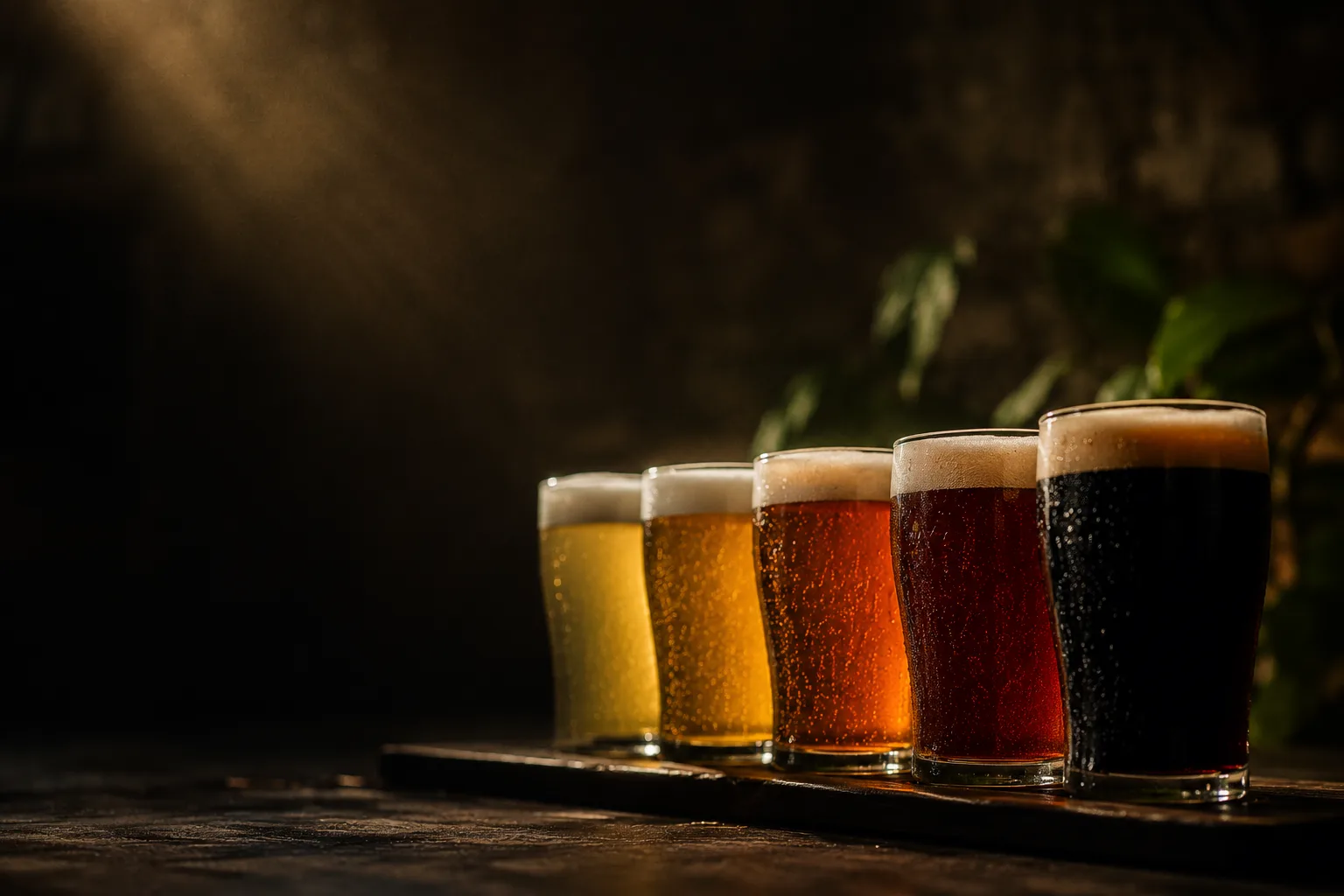
European Brewery Convention, the color scale. The higher the score, the darker the color. Around four to eight is straw yellow to pale blond, twenty to thirty yields amber and copper, and above sixty you are in dark brown to black. Color says something primarily about the malt used: the longer roasted, the darker the color, and the more coffee and chocolate notes you can expect.
Alcohol percentage
The alcohol volume percentage. Session beers are around four percent, most specialty beers between five and eight, and quadrupels, barleywines, and imperial stouts approach ten to twelve. More alcohol usually also means more body and a longer shelf life.
Serving temperature
The temperature at which the brewer prefers his beer to be served. Too cold makes a beer flat, because aromas only release themselves above about six degrees. Light, refreshing beers are at around five to seven degrees, blond and wheat beers around seven, tripels and amber beers around eight to ten, and heavy dark beers only around ten to twelve. So feel free to let a beer from the fridge stand for a while.
Food pairing
What the beer pairs well with. A suggestion, not a prescription. The idea behind it is simple: let the beer either complement or overpower the flavor of the dish. A creamy stout alongside chocolate enhances each other; a bitter, carbonated beer, on the other hand, cuts through the fat.
Beer styles you will find with us
Blonde — Light in color, easy to drink, usually six to seven percent. The starting point for those discovering craft beer.
Tripel — Belgian in origin, golden blond and robust, seven to nine percent. Often spicy due to the yeast, with a dry finish despite the alcohol content.
Double and quadruple — Darker and sweeter than a tripel, with caramel, dried fruit, and sometimes raisin. A quadrupel approaches ten percent and gains depth over the years.
IPA — India Pale Ale, hop-driven and usually distinctly bitter. Within the family, you encounter NEIPA (cloudy, smooth, distinctly fruity, little sharp bitterness), DIPA or double IPA (heavier and hoppier), and session IPA (same flavor, lower alcohol content).
Stout — Black, with roasted malt that provides coffee, cocoa, and sometimes licorice. An imperial stout is the heavy variant, starting at around nine percent.
Wheat beer and wheat beer — Brewed with wheat. Witbier is Belgian, often with coriander and orange peel; Weizen is German and owes its banana and clove notes to the yeast.
Barleywine, rye wine and mead — The heaviest category. Barleywine is a full-bodied, sweet barley wine, rye wine is the same but with rye, and mead is honey wine: strictly speaking not beer, but certainly at home in this list.
And furthermore — Saison (dry, spicy, originally a farmhouse beer), amber and scotch ale (malty and caramel-like), schwarzbier (black but surprisingly light), winterbock (dark and sweet for the cold months) and grape ale (beer with grapes).
What else you see on the label
Within a style, brewers often add a word to the label that says something about the approach. Next to each term, it states where you can find those beers.
West Coast IPA — The classic American IPA: clear, dry, and distinctly bitter, with resin and grapefruit. The opposite of a hazy. Available at IPA.
Black IPA — Also known as Cascadian Dark Ale. Black from roasted malt, but with the hop aroma and bitterness of an IPA. Smells of citrus, tastes of coffee and hops at the same time. Available at IPA.
Brut IPA — Bone dry and light-bodied, with plenty of fizz and hardly any residual sweetness, like a brut champagne. Fresh hop aroma without a heavy finish. Can be found at IPA.
DDH — Double dry hopped: cold-hopped twice after boiling. More aroma, not more bitterness. Primarily found in IPA.
Session — The same style, but lower in alcohol, usually under five percent. Meant to be drunk more than one. You mainly find this at IPA.
Pastry stout — A stout in which dessert has been brewed: vanilla, coconut, coffee, chocolate, or forest fruits. Sweet, full-bodied, and usually high in alcohol. Can be found at Stout.
Russian Imperial Stout — The heaviest stout, traditionally over eight percent. Thick, dark, and intense, with licorice, chocolate, and dried fruit. Available at Stout.
Barrel aged — The beer was aged in a wooden barrel, often formerly a whisky, port, or rum barrel. This imparts vanilla, wood, and part of the flavor of the previous contents. You encounter this at Stout and at Dubbel & Quadrupel.
Alcohol-free and low-alcohol — In the Netherlands, alcohol-free means up to 0.5 percent, and low-alcohol up to 1.2 percent. In the case of specialty beer, it usually concerns a lighter version of an existing style, not a different recipe. Among others with Tripel and IPA.
Brewing, storing and serving
Malt — Sprouted and dried barley. Provides the sugars that the yeast converts into alcohol, and determines color and sweetness. The darker roasted, the more coffee and chocolate notes.
Hop — Contributes bitterness, aroma, and shelf life. Added early in the boil primarily contributes bitterness, while added late, it contributes primarily aroma.
Yeast — Converts sugar into alcohol and carbon dioxide, and provides a large part of the flavor along the way. The difference between a Belgian Tripel and a German Weizen lies largely in the yeast.
Dry hopping — Add hops after the boil, during, or after fermentation. Provides a lot of aroma without added bitterness. The reason a NEIPA can smell like mango and still taste smooth.
Referral fermentation in bottle — Some yeast and sugar go into the bottle, allowing the beer to mature further there. Such beers often improve with age and leave a layer of yeast at the bottom.
Sediment — That layer at the bottom is yeast, not dirt. If you pour it in, the beer becomes cloudier and fuller in flavor. If you leave it in the bottle, it stays clear. Both are fine; it is flavor.
Shelf life — The date on the label is a best-before date, not an expiration date. Light and hoppy beers are best drunk fresh, as hop aroma disappears first. Heavy dark beers and bottle-aged tripels can last for years and often improve with age. Store upright, in a dark, and cool place.
Glassware — A tulip-shaped glass retains aroma, while a wide glass lets it escape. Next to every beer in our shop, you will find the glass recommended by the brewer themselves.